
How Much Fresh Produce Do You Lose Due to Dry Air?

Dry air costs fresh produce weight, shelf life and sales. Discover how dehydration occurs, what it can cost you each week and how Dry Misting helps retain moisture in your products.
Anyone who works in a fresh produce department will recognise the problem. A head of lettuce that was firm and fresh in the morning starts to wilt by closing time. A cucumber develops wrinkles near its stem. That’s water escaping into the air, and with that water, part of your profit margin disappears.
How Much Moisture Can Fresh Produce Afford to Lose?
More than you might notice at first glance. Fruit and vegetables consist of 65 to 95 percent water, with garlic at the lower end and lettuce at the higher end. From the moment they are harvested, fresh products start releasing water into the air. This process doesn’t stop in cold storage or on supermarket shelves.
Every percentage point of moisture lost means a percentage point of weight you can no longer sell. You purchase produce by the kilogram, but for products sold by weight, your revenue depends on how much remains after several days.
At around 5 percent moisture loss, the impact becomes significant. Many fruits and vegetables begin to visibly shrivel and can no longer be sold. Research from the University of Florida has shown that firmness and appearance can deteriorate even at lower levels of moisture loss.
The impact on your store depends on your product range, refrigeration systems and humidity levels. There is no single national figure that applies to every store. However, we do know that 45 percent of all crops produced worldwide end up as waste. Dehydration is one of the causes you can influence by maintaining humidity around your products with Dry Misting.
In short, dry air reduces product weight and shelf life, and at around 5 percent moisture loss, entire products may become unsellable.
Why Does Fresh Produce Dry Out in Stores?
The air inside fresh produce is almost completely saturated with water vapour. The surrounding air in your store is much drier. Moisture naturally moves from wetter environments to drier ones, causing products to release water. The greater the difference, the faster this process occurs.
Refrigeration increases this effect. The evaporator in a refrigerated display or cold storage room is colder than the surrounding air, causing water vapour to condense on its surface. The air circulating over your products is therefore drier than before. Some of the water or ice collected on the evaporator originally came from your vegetables.
Air movement also plays a role. Open refrigerated displays continuously circulate air across the shelves, removing the moisture surrounding the products. A head of lettuce positioned directly in the airflow will dry out faster than one placed further back.
Dry air, refrigeration and airflow reinforce each other. As a result, fresh produce can lose moisture particularly quickly in refrigerated displays.
Which Products Are Most Sensitive to Dehydration?
Products with a large surface area and thin skin lose moisture the fastest. Leafy vegetables, fresh herbs and mushrooms fall into this category. Apples and potatoes have firmer skins that help them retain moisture for much longer.
With meat and fish, dehydration becomes visible on the surface. The product becomes darker and duller, making customers more likely to choose something else.
In bakeries, dehydration can begin during proofing. Dough exposed to excessively dry air develops a dry skin. After baking, this can result in a dry layer between the crust and crumb.
The thinner the skin and the larger the surface area, the more vulnerable a product is to dry air.
How Much Does Dehydration Cost You Each Week?
A simple calculation makes the impact clear.
Imagine a fresh produce department selling 1,000 kilograms of loose fruit and vegetables per week at an average price of €3 per kilogram. If those products lose an average of 2 percent of their weight before being sold, 20 kilograms disappear into the air every week.
That represents €60 per week, or more than €3,000 per year. And that doesn’t even include heads of lettuce or bunches of herbs that become completely unsellable because they look wilted.
The figures in this example are hypothetical, but the underlying principle is real. Every percentage point of moisture loss means a corresponding reduction in revenue from products sold by weight.
The actual cost for your business depends on your department.
During a free consultation, one of our specialists will assess your product range and current levels of waste with you. You’ll gain insight into what dehydration is costing your business and what Dry Misting could help you achieve. The consultation is completely without obligation.
What Does Research Say About Humidification?
A study comparing electric and ultrasonic humidification during bread proofing provides valuable insight into how humid air can affect fresh products.
The measurements showed the following results:
| Measurement | Electric humidification | Ultrasonic humidification |
|---|---|---|
| Weight after proofing (35°C, 96% RH) | 0.40% lighter | 0.36% heavier |
| Dry skin on dough | Yes | No |
| Dehydration zone after baking (35°C, 80% RH) | 2.76 mm | 1.98 mm |
| Specific volume (35°C, 96% RH) | 5.05 ml/g | 5.75 ml/g |
| Time to reach a core temperature of 32°C | Approx. 35 min | Approx. 20 min |
The difference in weight is particularly striking. In the conventional proofing cabinet, the bread rolls lost 0.40 percent of their weight. With ultrasonic humidification, they weighed 0.36 percent more after proofing.
The dough did not develop a dry skin and did not stick to the baking tray.
This is partly due to the size of the water droplets. Ultrasonic vibrations produce droplets measuring just 1 to 2 micrometres. These droplets are so small that they evaporate almost immediately.
The air becomes saturated with moisture without water settling on the product’s surface. As a result, the product no longer needs to release as much of its own moisture.
There is one important distinction: this study examined bread in a proofing cabinet, which is a different environment from vegetables displayed on supermarket shelves. However, it does demonstrate how humid air can affect fresh products.
How Does Dry Misting Help Fresh Produce Retain Its Weight?
Dry Misting helps keep moisture where it belongs: inside the product.
A fine mist of purified water creates a humid environment around your fruit, vegetables, meat or fish. Products retain their weight without becoming wet, helping extend their shelf life by up to 50 percent.
This technology is already being used on a large scale.
Albert Heijn introduced Dry Misting in more than 800 stores. Through the European Fresh Demo research project, we monitored its effectiveness throughout the fresh produce supply chain. This work earned us the European Commission’s Horizon Impact Award in 2020.
PLUS supermarket owner Sabine Zondag has experienced the benefits in her own store. Her customers perceive the products as fresher, while she notices that they retain their colour better and stay fresh for longer.
Curious which system would work best for your department?
Explore our Dry Misting humidifiers or discover how the technology works for fruit and vegetables.
The same technology is also used for meat, fish, cold storage and bakeries.
It’s important to be realistic about what Dry Misting can achieve. It does not replace effective refrigeration or proper stock rotation.
Instead, it addresses one specific cause of food waste: the moisture products lose to the surrounding air.
By keeping the air around your products humid, Dry Misting helps retain moisture inside the products, allowing you to sell more kilograms of fresh produce.
Want to find out what this could mean for your store?
Request a free consultation with one of our specialists. Prefer to speak to someone directly? Call us on +31 (0)413 487000 or email info@contronics.nl.
Related articles
 Award
Dry Misting winner ECR Food Waste Innovation Challenge 2022
December 5, 2022 On Friday December 2th, we received the exciting news that we are the winners of ECR Food Waste Innovation Challenge 2022 in the category “Most Innovative Food Waste Solution”. We are beyond proud to be selected from along 100+ food waste innovations worldwide. We would like to thank ECR and Co:cubed for
Read more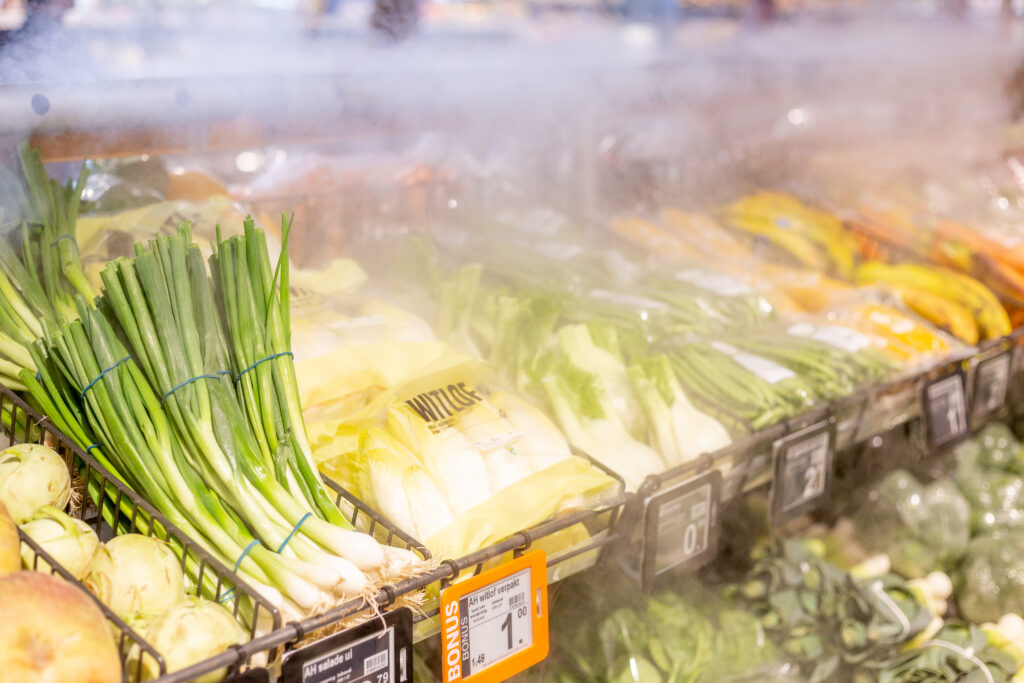 News
Albert Heijn Reaches Dry Misting Milestone
ESM Magazine – March 18, 2023 Dutch retailer Albert Heijn has equipped more than 700 stores with Dry Misting technology from Contronics. Dry Misting creates a fine layer of pure mist in the air around fresh produce on display without soaking the products or the shelves. The evaporation of the mist cools and protects products
Read more News
Press
“Contronics pursues accelerated rollout of Dry Misting, with support of Victus Participations”
August 23, 2021 – Victus Participations, the investment fund specialised in the Food & Agri sector, invests in Contronics together with management. With its proprietary technology, Contronics provides a solution to preserve the freshness of fruit and vegetables and prevent food waste. Contronics, based in Sint-Oedenrode (the Netherlands), offers retailers and other players in the
Read more